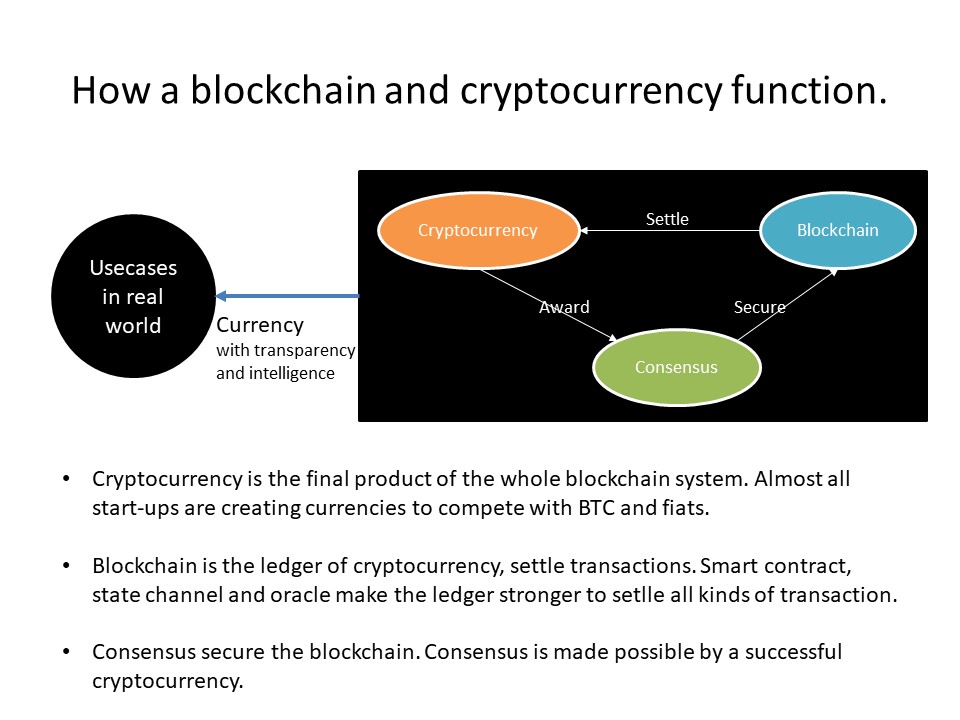
I make this to explain what is a public blockchain.
Crytocurrency is the final product of a blockchain. (Blockchain has some uniqe usecases too, but too small compared to usecases of currency. And if the cryptocurrency fail, the public blockchain will fail too.)
I believe that for a start-up to be viable, they need to develop not only the currency but also implement world-changing ideas, like, speeding up payments, offering better solutions, raising money for charity and so forth, to back their coins with a solid development plan that will persuade investors.
you are right. The team need do some thing make the coin better.
Not only functions like smart contract, state channel, Oracle are useful, and there are some non-tech things very important.
Transparent, fair distribution, good communication, decentralized, all these are important.
We are currently in a period of blockchain development where many such experiments are being run. The only conclusions drawn so far are that we are yet to fully understand the dexterity of blockchain protocols.
I do not think the blockchain has got fewer use cases. There are many projects now that use this technology as a secured database or a ledger.
What about consensus? Is that anything like proof of stake or proof of work? Have to learn more about it 
Blockchain have some usecases as a ledger, but it is too small compared to currency.
Currency’s marketcap should be trillions, and ledger’s should be millions. If aeternity aim to be a ledger, the 80 million marketcap for now is too much for it.
But cryptocurrency is not the only final product of blockchain, right?
Final products are a ledger and a currency.
(And some token, games run on the them, if you mean it.)
The successful currency is the key to make sure all other aspects successful. Currency fail, other applications fail.
I see. That’s why today’s blockchain platforms all have their currency inaddition to providing their initial services, like fantasy sports platform or whatever
If we look at the major cryptocurrencies, we find that they all share a set of underlying technologies that enable payment services and track transactions between banks and users.